Why You Should be Talking About Minor Miracles (and a free worksheet to make it easy)

First, what is a Minor Miracle? 

Minor Miracles are the little victories that happen every day that are often overlooked as you do critical work in your nonprofit organization.. 

Sarah wasn’t making any progress with Oliver, he was quiet and withdrawn. One day, Sarah was tapping her fingers and Oliver started tapping his. She quietly began singing and Oliver joined in.That moment marked a beginning for Oliver.

That’s a Minor Miracle. 

For Sarah, Oliver’s little song was a breakthrough. It deserved to be shared. But, sadly, moments like these are quickly forgotten as you go about your busy day.

What if you could capture these special moments?

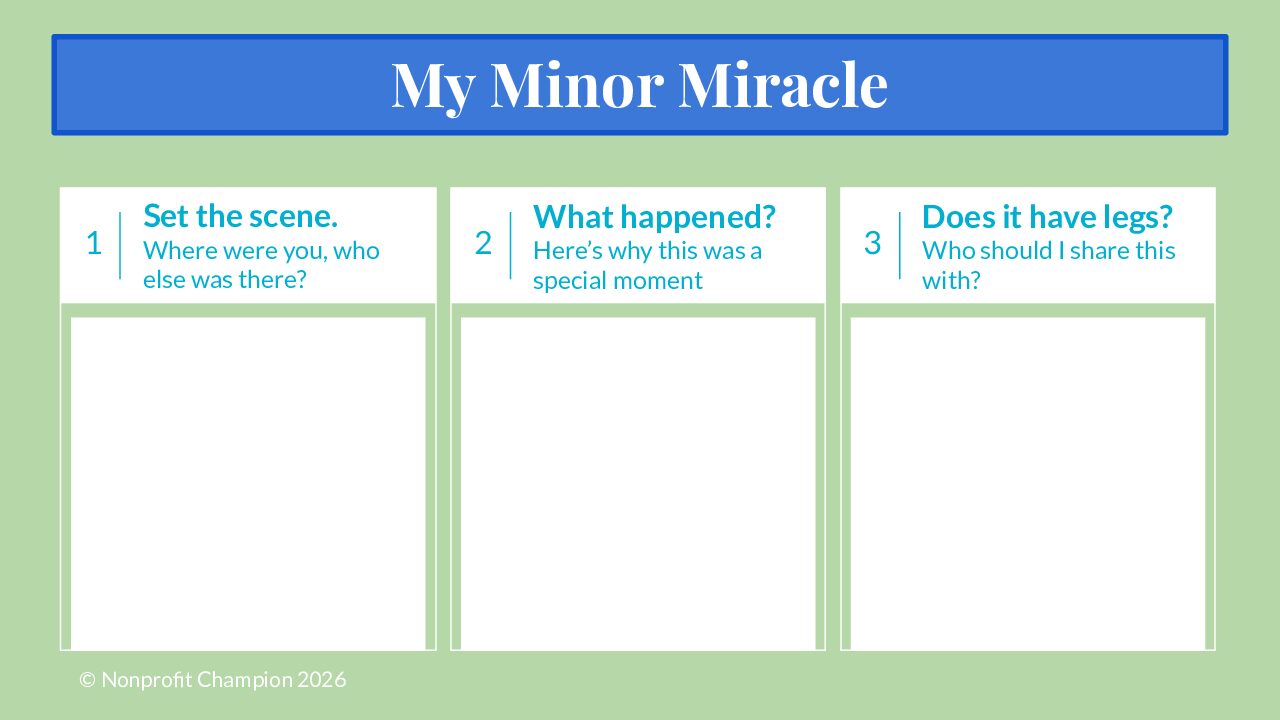
My Minor Miracle is a free worksheet I created for you. You, and everyone in your organization, can capture and share your Minor Miracles.

Here’s how it works:

  1. Set the scene. This is where you give a little background information so anyone who hears or reads about your Minor Miracle will understand.
  2. What happened? This is where you briefly describe what happened and why it matters.
  3. Does it have legs? Time for a little brainstorming here to decide how you, your PR or fundraising team, or anyone in your organization might share your Miracle. 

Every organization, no matter what the vision or mission, benefits from sharing success stories. Don’t let yours get away! Make it easy for everyone to capture Minor Miracles.

P.S. I often hear from people (who have heard me speak or read my book) that they dismissed Minor Miracles at first. But then they had an Aha! moment. They realized how such a small thing could have a big impact in their nonprofit. 

5 Steps to Sparkle!

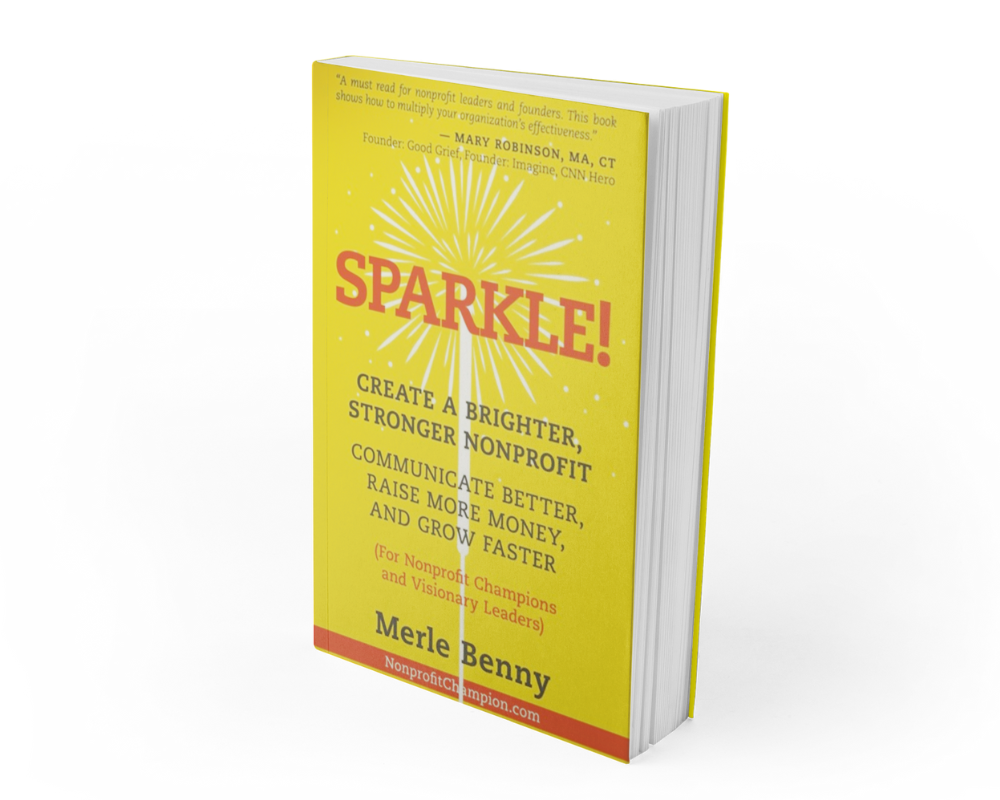
Hello Nonprofit Champions. I wrote a book for you.

Why?

The quick answer is this: I believe in nonprofits. I respect people that work in the sector. And I wanted to share my experience, what I have learned along the way.

You know, I started out writing about how to communicate better to raise more money and grow faster. And that’s in there, you can read it in Sparkle!

But along the way, I realized something else.

Sadly, a lot of people aren’t happy with their work life and a lot of organizations aren’t happy places to be.

So, the book takes you on a 5 step journey that leads to success. It also will help you (no matter what position you have in your organization) create a happier place to work.

Snapshot: A Better Way To Make Nonprofits Work

You don’t need to work harder.

What you may need is a BETTER way to work and to make your nonprofit work better

A simple method that builds on what you already have. One that puts your mission front and center, while it creates opportunities for partnerships, and a growing donor base.

All that and a happier, healthier workplace for you!

Sparkle! builds on what you already have.

It inspires and prepares you to share the great work you are doing with the world. And it makes it possible for you to feel good while you are doing it.

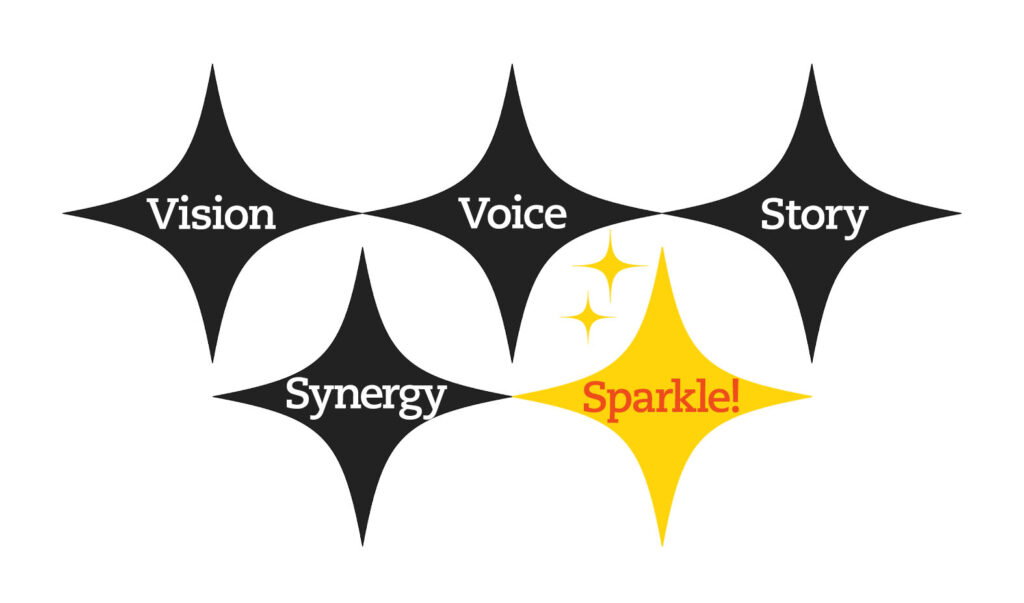
These are the 5 building blocks of an organization with Sparkle!

VISION

Step 1: You’ve got places to go! Your journey begins with a clear vision. Discover the words to communicate that vision and you are ready to share them with the world. That’s a magic start, or restart, of your organization.

VOICE

Step 2: If one person sharing your vision is good, imagine multiplying that by 10 or 100 or 1000! Beautiful, heartfelt, diverse voices, sharing the good news and the great need.

STORY

Step 3: Stories are magical! When storytelling becomes part of your culture, that magic means happier, engaged employees and plenty of great news to share with the community.

SYNERGY

Step 4: Weaving a network of connections from many sectors puts you at the center of possibilities. Like a living database, it builds dynamic networks. That means opportunity for you and, ultimately, for those you serve.

SPARKLE!

Step 5: It’s the magical difference that makes your organization communicate better, raise more money, and grow faster. Plus, you’ll love going to work everyday!

Start where you are.

You may be in a senior position as the Founder of your nonprofit, the Executive Director, or the Board Chair. Or maybe you’re a Director of Development, Marketing, or HR. Or you may be aspiring to one of those positions. Whichever it is, it’s the right place to begin looking ahead to a happy, growing organization, ready to take on the world.

PS Sparkle! is available now.

PPS It’s a quick read, it is short and to the point. I’m not wasting your time. No fluff, just good usable information and ideas.


Use your words.

“Great leaders must have two things: a vision of the world that does not yet exist and the ability to communicate that vision clearly.” Simon Sinek

Communication is a basic element of your success.

Think about your heroes. What do they all have in common? They speak, they tell stories, they get your attention through words.

Throughout history our most respected and memorable heroes are great orators, or great writers, or both. Whether they are founders, philosophers, politicians, scientists, leaders in religion, the art, or business, the most influential are also the best communicators.

From ancient Greeks to hip-hop artists, great communicators get attention!

Today, among your personal heroes may be an elected official, a speaker with a motivational podcast, or an inspiring author. They have a voice and they use it to connect.

That’s what great communication does.

Why does this matter to you?

When you become a strong communicator you have the power to influence people. You make connections.

As a nonprofit leader at any level, your communications will win advocates, donors and volunteers. They will make you and your organization stronger and more influential.

✔️Use your words to build a bigger, better organization.

✔️Use your words to attract donors.

✔️Use your words to make the world a better place.

Communication is a key to success. Start with a clear vision for a quick connection. The rest is magic. 


Merle Benny, author of Sparkle!, writes and speaks to inspire Nonprofit Champions. The discovery that happy healthy nonprofits raise more money and grow faster (and, in turn, make the world better) is the result of a lifetime of service to nonprofit organizations. Merle has raised millions, been the voice of numerous organizations and continually brought innovation to the sector. Merle is a developer and presenter of the Nonprofit Consultants Institute.

You need money. You need time. You need people.

You need me.

For over 20 years I’ve worked with nonprofit founders, leaders, boards, and dreamers to build stronger organizations, create memorable brands, increase funding, and become Leaders @ the Center™.

Build a stronger nonprofit, one that is ready for the future. Sharpen your vision, hone the message. Retain and inspire employees. Build strong, collaborative networks including funders.

A Gala for the Poor?!?!

This morning I read, on social media, a plea for donations. The cause? To help the nonprofit survive!

Here is an organization, with a long history, that has lost its way and doesn’t know what to do about it. Instead of telling a story of hope and possibility, they cry and ask to be saved.

Yes, the intentions are good, but the result won’t be.

Nonprofits succeed when they create an ever-growing base of support and love. Yes, they need to be loved.

Nonprofits exist to make our world a better place. Every single organization – and there are 10 million in the United States alone – is created to solve a problem.

Creating, maintaining, and growing a network of support and caring is the only way a nonprofit can succeed.

Yet, many fundraisers and development professionals put their energy into activities that divert their attention. I’ve seen it too many times. Employees spend months planning a gala. Yet their mission is to feed the poor or shelter the homeless. That’s a disconnect and a misuse of resources.

Begging for survival doesn’t work. Galas aren’t sustainable. But building a strong network of caring – and GIVING – people does.

This blog is an exploration of how to empower everyone in the organization to contribute to the growth, opportunity, and possibility for your nonprofit.


Merle Benny, author of Sparkle!, writes and speaks to inspire Nonprofit Champions. The discovery that happy healthy nonprofits raise more money and grow faster (and, in turn, make the world better) is the result of a lifetime of service to nonprofit organizations. Merle has raised millions, been the voice of numerous organizations and continually brought innovation to the sector. Merle is a developer and presenter of the Nonprofit Consultants Institute.


You need money. You need time. You need people.

You need me.

For over 20 years I’ve worked with nonprofit founders, leaders, boards, and dreamers to build stronger organizations, create memorable brands, increase funding, and become Leaders @ the Center™.

Build a stronger nonprofit, one that is ready for the future. Sharpen your vision, hone the message. Retain and inspire employees. Build strong, collaborative networks including funders.

Onboarding: An Action Plan for Nonprofit Success

I read about a 3rd grade teacher, I’ll call her Ms. Smarts, who took an unusual approach. At the start of each school year she put aside the lesson plans. She ignored the usual curriculum.

Instead, for the first three months she worked at nurturing her students.

Ms. Smarts cared about her students self-esteem, teamwork, and potential. She wanted to give each of the students an opportunity to explore and experiment without grades or tests. She wanted learning to be fun, not intimidating.

Finally, once they were ready, she began the required lessons.

They soaked them up!

This story has always stuck with me. I wonder what would happen if we treated new employees, volunteers, and board members the same way.

What if we started with exploration and teamwork?

What if we allowed them to discover and share the vision of the organization?

Marshall Ganz, of Harvard Kennedy School, worked with the young campaigners for Obama in his first run for the presidency. He challenged them to explore three stories: the story of self, the story of us, and the story of now. This exercise prepared the recruits to go out and campaign, fully prepared to share compelling stories.

Like the 3rd grade students, the Obama recruits had the opportunity for self-discovery and teamwork before they went to work.

You already know the outcome of the Obama election.

Guess what happened with Ms. Smarts students…They came out ahead at the end of the school year! They achieved higher scores on the standardized tests and they were fully prepared to move onto 4th grade. 

You can adapt these approaches to fit your organization, here’s an Onboarding Action Plan to get you started (btw, this works for forming teams of existing employees and volunteers too):

  1. Share the vision. Give employees and volunteers a big picture view so they see where they fit today and also where they may go in the future. Encourage possibility. This is especially important for workers who may not be in the office or may be siloed in a department.
  2. Encourage gathering. Make teamwork part of the onboarding process, allowing time to get to know each other and encouraging sharing throughout the organization. Allow new recruits to use their voice and be part of exploratory conversations. Great ideas and tools are available at Liberating Structures (download the app). 
  3. Create your story library. Know and share the founder’s story and other essential tales of your organization’s founding and growth. These shared stories are the basis for a common knowledge, understanding, and commitment to the founder’s dream and the vision of the organization. They might be in writing or on video to share at events and social media.
  4. Collect stories. Create a way for your employees and volunteers to share their successes. I call them Minor Miracles, the little things that happen but might be overlooked. A mental health organization gives everyone an opportunity to share their miracle of the month. These add to the library, ready to be shared.
  5. Listen. Every person brings something unique and special to your organization. Make sure you hear what they say and honor their stories. Discover the unique qualities of everyone so you can identify how they fit in and enhance the organization.
  6. Facilitate connection. As you get to know your new employee, board member, or teammate, you will find lots of opportunity to make connections. As each person is enabled to build a network, the organization as a whole is strengthened. Network Weaver is a great source for resources and tools.

Every employee and volunteer has potential to contribute to your organization’s growth. It’s up to you to show them the possibilities. Creating a culture of sharing, storytelling, teambuilding, and connecting will build an organization ready for the future.

Merle Benny, author of Sparkle!, writes and speaks to inspire Nonprofit Champions. The discovery that happy healthy nonprofits raise more money and grow faster (and, in turn, make the world better) is the result of a lifetime of service to nonprofit organizations. Merle has raised millions, been the voice of numerous organizations and continually brought innovation to the sector. Merle is a developer and presenter of the Nonprofit Consultants Institute.

On Becoming a Nonprofit Champion

Merle Benny

Nonprofit Champion is more than the name of the business I run. It’s even more that the work I do every day, supporting nonprofits.

It’s the result of a lifelong dream.

Merle Benny

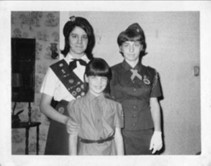
It started when I was a Brownie (that’s a  young Girl Scout). I was in the second grade and my mother was the troop leader. I wasn’t very good at crafts, failed at selling cookies, and couldn’t carry a tune to save my life. I had skipped kindergarten, so I probably didn’t know a lot of important life lessons.

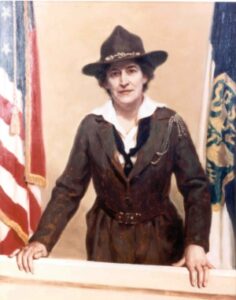
Then I heard about Juliette Low.

Learning how this woman (a bit eccentric but I didn’t know that yet) had started an organization just for girls was eye opening. It was not just my little troop, but there were other Brownies in other schools all over the country. Wow. That was impressive to my little beanie-wearing self.


Juliette became my idol. She taught me that girls matter. She taught me that you could create a movement and that movement was called a nonprofit.

I went on to learn a lot of things as a Girl Scout. Many of them impacted my life but nothing was more important to me than the simple lesson I learned from the Juliette Low story: If you have a vision you can create something much bigger than yourself.

I’d like to say that there was a straight path from that discovery until today. There was not. I did many things in my career, including a short (disappointing) stint working for the Girl Scouts. But as I used the leadership skills I learned in Girl Scouts and became successful in my marketing career, thoughts of her never went away. I knew I still wanted to inspire possibility like she did.

That dream landed me right where I needed to be. I began working with nonprofits, using my marketing communications expertise. I realized I did not want to be Juliette Low, I wanted to create Juliette Lows.

I’m sharing this story with you because it is the reason I champion nonprofit founders and leaders. It is also the reason I believe your possibilities are endless. Juliette Low started Girls Scouts 108 years ago. Imagine the millions of girls it has served! Imagine how much the lives of girls and women have changed in that time! Yet, it, like so many great organizations, has adapted and continues to fill a need. That’s what nonprofits do.

Juliette Low helped me discover my purpose. Today as I write and speak about adding Sparkle! to your nonprofit organization, I remember the story of Juliette and all the great founders I have had the honor of knowing and working with.

Dig deep for your purpose, tell your story. You can change the world. Act like Juliette, even if you are just starting your career.


Merle Benny, author of Sparkle!, writes and speaks to inspire Nonprofit Champions. The discovery that happy healthy nonprofits raise more money and grow faster (and, in turn, make the world better) is the result of a lifetime of service to nonprofit organizations. Merle has raised millions, been the voice of numerous organizations and continually brought innovation to the sector. Merle is a developer and presenter of the Nonprofit Consultants Institute.

Lessons from the lectern, becoming a great speaker

I’ve made every public speaking mistake.

At one big event, I forget the words I had memorized and stood there like a dummy with my mouth open and nothing coming out. Embarrassing!

I’ve been boring, talked too fast, and read every word.

It took practice to get better. I had to take chances, get honest feedback, and seek out opportunities to speak. It was worth the effort.

You have a voice that deserves to be heard.

You have the power to recruit volunteers, attract donors, and inspire action. The better you communicate, the greater success you’ll have.

Good communication is the basis for nonprofit success.

Throughout history our most respected and memorable heroes are great orators, or great writers, or both. Whether they are founders, philosophers, politicians, scientists, religion, artist, or business leaders, the most influential are also the best communicators .

From ancient Greeks to hip-hop artists, orators use the stage and written words to get their message out.

Today, among your personal heroes may be a great conversationalist in your family, a speaker with a motivational podcast, or an inspiring author. They have a voice and they use it to connect.

Good communication is the basis for nonprofit success.

Explore opportunities to find your voice. Your organization needs you to share the dream and attract support. Practicing your communication skills is key.

You have the power to make a difference. It starts with communication. Look for opportunities to practice your speaking skills, get publicity, and spread the word. Here are opportunities to explore:

Toastmasters. Clubs all over the world give you the chance to practice and learn great speaking skills.

National Speakers Association. The regional and national club offer training and events.

Podcasts. Take a look at the podcasts for nonprofits, or for your cause. They are often looking for guests! Here’s a list of popular nonprofit podcasts.

Tours. Inviting people to come, hear, and see your work is a perfect way to practice your skills while benefiting your organization. Virtual or in-person, it’s a fun, smart way to make new friends for your cause while you become a great speaker. Learning to inspire people to care by telling your story in 10 minutes or so, is the best thing you can do for your organization.

Speaking. Look for easy entry points to the speaking world. Talk to a local group about your organization. Share your own story or your founders story with a group of volunteers. Accept invitations to sit on panels.

Your organization needs you – as a dreamer, messenger, and champion.


Communication: 4 reasons it matters today

Building an organization of communicators is more urgent every day.

There has never been more urgency for nonprofits to step up their communications. Each and every employee and volunteer should be empowered to speak for the vision and mission of the organization.

Why now? Here are four reasons why it matters every day in 2022 – on the front lines of service, in your social posts, on your website, and at your community events.

Let’s explore why that is so important right now and how you can use this moment to create an organization that continually moves closer to your Vision:

1. Diversity – There is a comfort level and a natural tendency to speak with people that look like you, as a result you continue to build an organization of like-minded people with similar world views. Additionally, nonprofits haven’t done much better than for-profits in diversifying their staffs. The vast majority of nonprofit managers and directors are white.

The way to go beyond that is to intentionally create a more diverse organization and to acknowledge the diversity that already exists but may not have a voice. You honor and support everyone by giving them access, tools, and information needed to share the Vision.

A diverse group, with their own experiences and perspectives, will communicate the organization’s message, building a network of varying ages, races, economic standing, and lifestyles for your organization.

2. Crisis – The pandemic is a lesson in rapid change and adaptation. Communication has taken new forms as a result. The quick replacement of in-person events, from staff meetings to fundraisers, showed what could be done in ways we wouldn’t have imagined as recently as 2019.

Supervision no longer requires being in the same room, overhearing conversations, or eating lunch together. Those organizations providing emergency services, health care, and education saw frontline workers, whether or not they were prepared, become the voice of their organizations. Crisis showed you how important it is to have independent workers, able to communicate for the organization.

3. Technology – Every department and service of your organization depends on technology. Those with the skills to develop and use these tools have become critical players in every nonprofit. Whether they are using social media for marketing, online platforms for events, fundraising apps, measurement tools, customer relationship management (CRM) programs, or accounting software, it is essential that they have a full understanding of the Vision so they can support it and deliver it through technology.

4. Advocacy – Nonprofits are called on to speak for those they serve. Being advocates, in addition to providing service, has become critical for growth and success. With record unemployment, wage disparity, and health threats it is critical for many voices to advocate, not just for those you serve but for employees, clients, and the community at large.

Communicate is step one in your growth strategy. By becoming a communicator, and offering that opportunity to others in your organization, you are giving yourself, and them, the ability to lead your organization in unprecedented ways.

Merle Benny
Merle Benny, Nonprofit Champion

Merle Benny writes and speaks to inspire Nonprofit Champions. She believes that every nonprofit is created with love and deserves to thrive. Her marketing communications expertise and years of study led her to write Leader @ the Center. Everyone has the potential to be a leader and a Nonprofit Champion.

Leader @ the Center

I loved Suzi the first time I met her. She was a new employee and the youngest person in the room. Yet, there was something about her.

Wherever she was things were happening.

As I worked with her on several different projects, I began to see what it was that made her so special. Suzi is a leader.

If we limit the idea of leadership to one person at the top, we don’t make room for people like Suzi. That’s a big loss.

The traditional nonprofit model limits leadership opportunities. This has made it difficult to attract and keep a motivated workforce. It’s time to take a fresh approach and recognize leadership at every level, in any role.

When you empower employees, volunteers, and board members by giving them the tools, resources, and confidence to speak, they contribute to building a diverse, sustainable community of support.

The first step is to appreciate the value of building an organization of great communicators. Download Merle’s ebook, The Secret to Nonprofit Success, to learn why you want to communicate your vision and how to get started.

When you begin to see communicators as leaders, leadership shifts. It is no longer limited to the top. You have empowered employees, board members, and volunteers, to speak up for the cause. This is Leader @ the Center™, a new approach to empowering individuals, activating strong networks, and building sustainable organizations. 

Why should you be a Leader @ the Center?

Leadership belongs to everyone who shares the organization’s Vision and builds a network.

This new leader is a connector, continually weaving a network and mobilizing an ever-growing system of support and caring.

Depending on the leader’s area of expertise and role in the organization and in the community, that network might be donors, foundations, business leaders, other nonprofits, service providers, volunteers, or any combination. The circle may also include service recipients, customers, and clients.

You, as a leader, are at the center of your own network.

Why should you encourage others to be?

The freedom that this new perspective gives to employees, board members, and volunteers is immeasurable. Now you have a large active team moving in different circles towards the same Vision. Remember, this happens simply by empowering everyone to communicate with confidence and passion about your work and the bigger dream for a better world.

This mobilization multiplies your impact. More connections lead to more contributions. More contributions lead to stronger progams. Stronger programs lead to greater outcomes.

No longer is the Executive Director going it alone. Now they are the team captain with a winning team, moving independently towards a shared goal. Leader @ the Center can exist in your current structure or be the catalyst for moving away from the hierarchal, pyramid model to a self-managed model.

Suzi isn’t bossy, she respects authority and understands her role, but she’s definitely a leader. She takes action on the spot. As Doug Sundheim writes in Forbes,* leadership is “critical and collaborative thinking and action given what you see in front of you.” That’s what sets Suzi apart.

You need Suzis at every level of your organization.

Here are some points to consider before moving on to creating messages and preparing Leaders @ the Center to connect. Empowering many to share the Vision addresses a range of existing problems and obstacles to success:

Capturing hearts. Getting attention, inspiring action, and driving change are fundamental roles of a nonprofit organization. Emotional connections make these happen. The more voices the better, yet employees and volunteers may not feel empowered to speak of their experiences and share their passion.

How Leader @ theCenter helps: Having many communicators in your organization captures more hearts and minds. Each brings a unique voice and experience to your message, making your appeal resonate. Multiply that by ten or twenty and you have opportunity where it did not exist before. Passionate voices lead to active volunteers, participants, and donors.

Retention. Your work is easier when turnover is low. Retention of employees, volunteers, and board members brings consistency and a strong base of support. Recruitment and training are expensive and time consuming, taking you away from your mission.

How Leaders @ the Center helps: Engagement is key to long term relationships. Creating an organization of communicators gives everyone the opportunity to engage. The feeling of belonging, being needed, and having a voice are empowering and rewarding. And they are reasons to stay.

Motivation from the start. Young, new employees bring energy to your organization. It is challenging to attract and retain them. A lack of opportunity to actively engage in the Vision causes many to turn away from the organization or nonprofits in general. They seek a position that allows them to grow, act, and share.

How Leader @ the Center helps: Giving a voice to these most enthusiastic, inspired employees and volunteers motivates and energizes your youngest, and often, most diverse workers. These may also be your most tech savvy employees, using tools to enhance the work and spread the message. The rewards are double: you keep them engaged and their voices attract a new base of support.

Demand for services. You are challenged to continually deliver an ever-expanding range of programs and services. These demands often come from funders. It becomes a Catch-22: you can’t have the money without the services and you can’t deliver the services without the money.

How Leader @ the Center helps: Your newly engaged and empowered employees, volunteers, and board members are energized and productive. Engaged employees are happy employees. They are multiplying your contacts and contributing more

Steady flow of money. The majority of nonprofits identify finding and maintaining reliable sources of funding as their greatest need. You are challenged to maintain existing funding sources while identifying new ones.

How Leaders @ the Center helps: Empowering everyone in your organization by giving them a voice multiplies your exposure while creating the momentum that produces results for you, your service recipients, and your funders. With an organization rich in resources, you are on a path to success.

Becoming a Leader @ the Center feels good! Creating more leaders is your opportunity to build momentum, reduce expenses, satisfy workers, increase productivity, and raise more money.

What can you do today to create more leaders in your organization?


Merle Benny

Merle Benny, Nonprofit  Champion.

Merle is the voice of Nonprofit Champions everywhere. She writes and speaks to inspire more nonprofit leaders in the community and world. She loves connections! Email merle@nonprofitchampion.com or follow Nonprofit Champion on Facebook or LinkedIn.